
Our History
St. Stephen’s Episcopal Church is really a pioneer church, the oldest church building still in use in Monte Vista. Two families were instrumental in starting the Episcopal Church in Monte Vista. Mr. and Mrs. Harry Francklin and Mr. and Mrs. Blackmore came here from England in the 1880s. Far from their homeland and own church in England, they were anxious to establish a church so that their children might have the advantages of religious training and the influence that is so important.
They collected funds from their friends here and in their home country. In April, 1888, St. Stephen’s Church was started. The church is a replica of a small church in England. It was said to be architecturally perfect.
The Monte Vista Town & Land Company gave the lots to the Bishop and Chapter of the Cathedral of St. John the Evangelist in Denver, Colorado. Lineage & Parker were the contractors. First payment was made on the building April, 7 1888; final payment was made in June of the same year!
The original plan for the church had a chancel, but as funds were not sufficient at the time to build this, an arch was built and filled in so that the chancel might be added later. The church was not plastered on the inside for many years due to lack of funds.
According to an item from the San Luis Valley Graphic on February 6, 1890 the first services were held in the church February 2, 1890 by Rev. Amos Bannister. An item in a later paper stated that a new organ had recently been received for the new St. Stephen’s Church.
On March 6, 1890 the following article appeared in the Graphic: “The Rt. Rev. Bishop Spalding of Denver will conduct consecration services at St. Stephen’s Church on March ninth at 11:00 a.m. This church will be consecrated entirely free of debt. The Bishop preached a very able sermon from the text—“My house shall be called a house of prayer.” The offering was for mission work in the Diocese of Colorado. We welcome the new church to Monte Vista. It has made an enviable record.
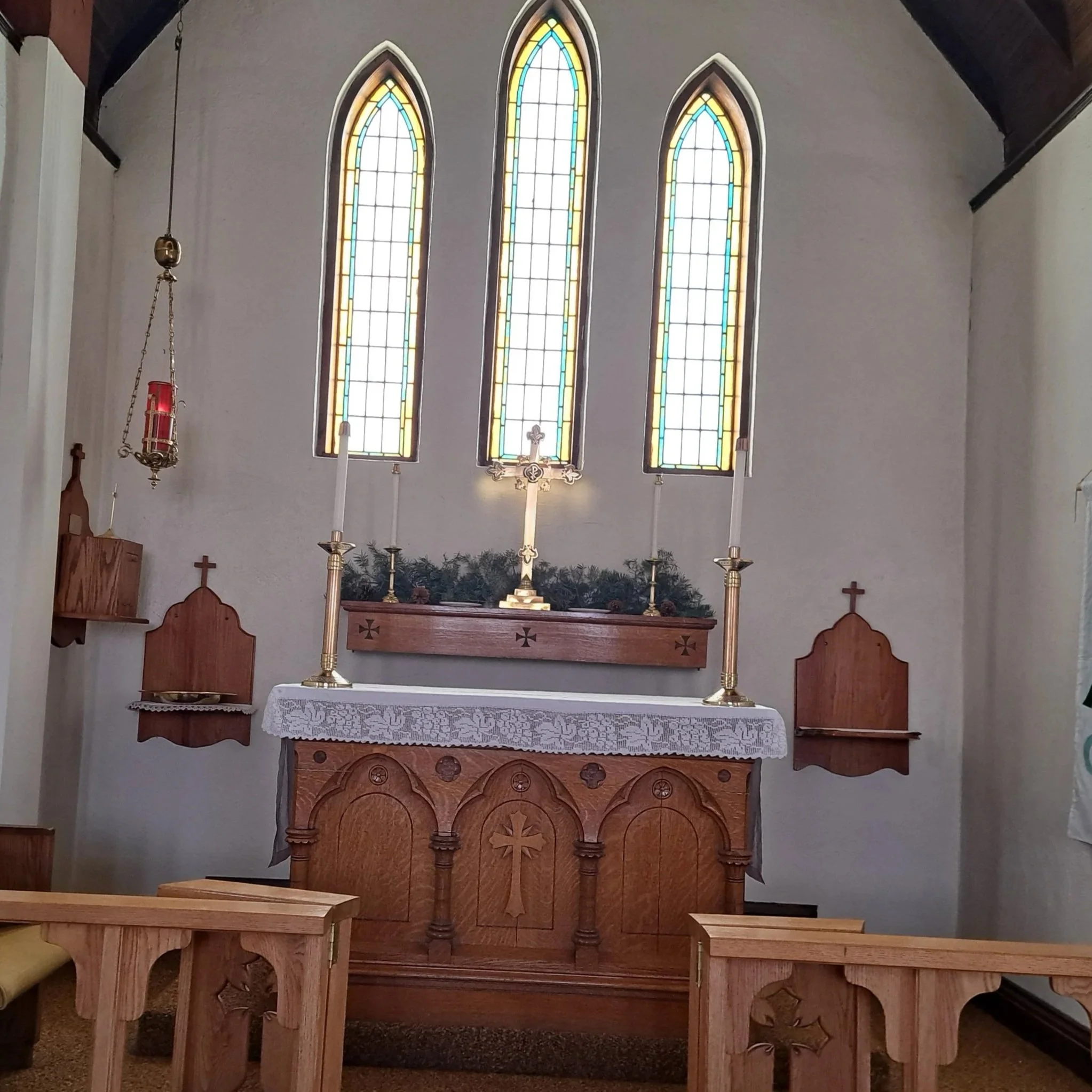
The chancel in the church was added in 1913 in memory of Bertha Evitts, a sister of Mrs. Harry Francklin. The first reredos was made of wood by Rev. Cone. Mr. Campbell and his two sons, James and Robert, made the font of native stone [Fish Canyon Tuff which is also the same stone the church was constructed with,] donating their work. A Miss Wright made the first Altar cloth and hangings.
In 1944, Rev. Robert Whiting came and ably guided and ministered through those years of ups and downs. He was also Rector of St. Thomas in Alamosa, Vicar of Epiphany in Del Norte, St. Augustine in Creede, and Little Shepherd in the Hills at Crestone. [Indeed, circuit riding priests are the norm for Colorado and the Western United States!]
New windows of leaded amber glass were built and installed in August of 1956 at a cost of $583.00. These were paid for by St. Stephen’s ECW and other contributions. Between 1955 and 1962, the Sunday school had grown so much that a new building needed to be built. With $1000 donated by the Phipps Foundation in Denver and ECW fundraising, a new building was financed and built. It was dedicated in August of 1962.
The ECW also furnished the building with folding chairs, tables, electric stove, movable partitions, which were used each Sunday for classrooms. Many things were donated for the kitchen, bathrooms and office.
While the Parish hall was being built, we also did some remodeling in the church. The Sacristy was moved from the back of the Church to the Parish hall, thus giving ample space for the Vicar and Choir to be. Also storage space for vestments, robes, etc. Seating space was also more adequate.
On March 9th, 1965, the 75th anniversary of the consecration of the Church of St. Stephen the Martyr was celebrated. Bishop Edwin B. Thayer came down from Denver for the occasion. Confirmation services were held for four persons. Brunch was served in the Parish hall after the service and a delightful day was spent.
In 1969, more remodeling was done in the Church. New pews were given as a memorial gift from the family of one of our faithful members. These replaced the original pews that were installed when the Church was built. Choir pews were presented by several members. Beautiful wall to wall carpeting was a gift from St. Stephen’s women’s guild. Storage cabinets were built in the back for Altar linens, candles, hangings, Altar accessories, etc. New lighting fixtures were also installed and the Church redecorated.
After Fr. Whiting decided to work primarily with St. Thomas in 1973, Fr. James Bauer, head of radiology at the Alamosa Hospital, became the resident priest at St. Stephen’s. Fr. Bauer said that he remembers the church having a budget of $2000 for the year, while the women’s guild budget was $4000!
“We didn’t have very many people, maybe four or five communicants each week. So I started recruiting people for a choir, because I love to sing and wanted a choir.” He said the choir and congregation slowly grew. When Bishop Frey came to Monte Vista to install Fr. Bauer, the two had a little talk. Fr. Bauer asked the Bishop what he needed to do to get the Church to grow. Bishop Frey told him he had never failed to see a church grow that didn’t reach out and share God’s word. Fr. Bauer never forgot that.
Although the congregation was small, the Bishop’s Committee decided to take ten percent of the income and give it into a fund to feed the hungry and clothe the poor. The rest of the congregation thought that was crazy, but with in a month, the giving had doubled. At that point, the Committee decided to give twenty percent of the income to the poor, with a portion of that going into the Bishop’s discretionary fund also. Again the giving doubled. St. Stephen’s then had an $8000 a year budget.
Fr. Bauer remembers doing many Cantatas for Easter and Christmas. The strong choir also used the talents of other musicians in the church by performing some selections using brass instruments. Don Curtis was one person Fr. Bauer strongly remembers playing his trumpet for special occasions. One Palm Sunday, the church decided to do a “Parade for the King.” Somehow they got an organ hooked up on a big truck and recruited a few people to play their horns. As they marched around the block, they picked up people from neighboring churches to join in the parade. The second time around, those people dropped off at their churches to celebrate Palm Sunday. It was a cold day, and Fr. Bauer said he is sure he looked like a linebacker with his ski jacket underneath his chasuble!
Another particular date he remembers is the picnic the church went on June 10th of one year. They went up to the mountains and our wonderful Colorado weather blessed the group with rain, hail, and snow all on the same day!
In 1974, the two lots and small building originally owned by the Church were re-purchased and the building was used as the Vicar’s office, for discussion groups and other Church business. The Church now owns a full half block of five lots and three buildings and is entirely free of debt.
In 1977, Fr. Bauer left Monte Vista to move to Victoria, Texas. (As of 1990,) Fr. Bauer and his wife, Carol, lived in Indiana, Pennsylvania. The Rev. Norman Nicholls followed also in 1977 and the congregation had grown to more than 100 souls. In the early 1980s, the Rev. Ralph Evans and his wife Pat came to St. Stephen's. Under their guidance, a youth group had formed and children's liturgies were instituted. In the mid-80s, the Rev. John and Ruth Wengrovius came for a short time, being newly returned to the United States from a mission in Zambia, Africa. An Emergency Food Bank was set up in one of the out buildings by members of St. Stephen's with the intent to serve the Monte Vista Community. The Rev. George Lewis then became our Vicar in 1985, along with St. Thomas, and a loose partnership between our two churches began.
Following Fr. Lewis was the Rev. Don Trimboli who came to the San Luis Valley from the Diocese of New York. It was at this time both churches signed a partnership agreement with Fr. Trimboli as Vicar. At. Fr. Trimboli's passing in 1992, the Rev. Jim Ragsdale became Intirim Vicar followed by the Rev. Kathy Glenn in 1993. During this time, another congregation formed with St. Thomas and St. Stephen's—St. Francis Episcopal Church South Fork. This partnership became the Episcopal Mission of the San Luis Valley. Together, the partnership birthed Christian Community Services, the West Valley Community Meal, the Episcopal Church Women guild, the Altar Guild, St. Brigit's Daughters of the King Chapter, the Monte Vista Emergency Food Bank, the Alamosa Food Bank, and numerous other ventures with individuals and the San Luis Valley Community.
In 2005, the Rev. Warren Hicks succeeded the Rev. Kathy Glenn who moved to sea level for health concerns. At this time, the EMSLV innovated the Lay Pastoral Leader program by which licensed Lay Leaders serve the already consecrated bread and wine in a lay led service written for this express purpose. In 2008, the Rev. Warren Hicks was called to serve in Worcester Massachusetts and the EMSLV disbanded. Also in 2008, St. Augustine's Episcopal Church, Creede, joined St. Stephen's in a Liturgical Partnership which allowed both congregations to continue with the Lay Pastoral Leader services.
The Rev. Scott Hollenbeck came to St. Stephen's fresh out of Seminary. He traveled to the San Luis Valley from Pagosa Springs. He helped our congregation streamline services since travel was an issue. Services went to Holy Eucharist the first and third Sundays, Communion from the Reserved Sacrament one Sunday, and Morning Prayer at the end of the month and on the fifth Sundays. He also celebrated on Christmas Eve, Sundown Ash Wednesday service Shrove Tuesday, Palm Sunday, and Easter Sunday. When Fr. Scott was reassigned to St. James, Meeker, St. Stephen's went through a cast of multiple supply priests.
Some historical material borrowed from a sermon preached by the Rev. Doug Ray, June 3rd, 2001. The newest historical information was shared by Missi Stone. St. Stephen's celebrates 136 years in 2026.
Excerpted from Anne Marie Kimberling’s compilation from the 100th Anniversary booklet, 1990.
Early history was collected and written by Mrs. Dorothy Shwartz in 1965 for the 75th Anniversary celebration.